
Most bettors assume the odds are soft — that if you watch enough tennis, you can spot where the bookmaker has it wrong. So we checked. We took 28,563 ATP & WTA matches (2020–2026), and for each player used the best price available before the match, turned it into the chance it implies, and compared it to how often that player actually won — across 57,126 outcomes.
The market already knows
At every price level, the actual win rate lands within about 2 points of what the best price implies. The biggest gap in any band was 1.9 points. The only hint of the classic “favourite–longshot bias” is at the extremes — the longest shots won about a point less than their price suggested, the heaviest favourites about a point more — and it’s far too small to build a strategy on.
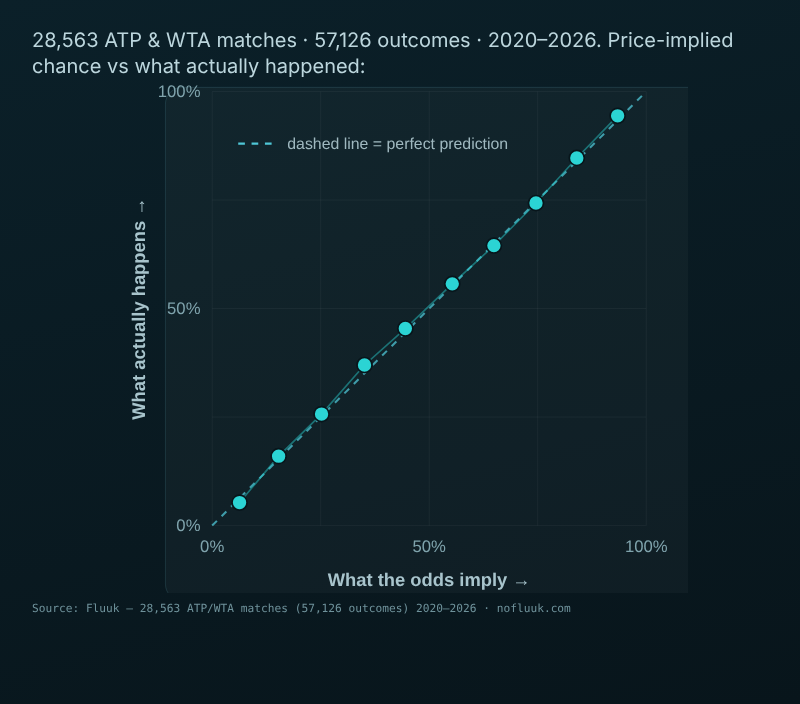
The odds imply ~15% → players actually won 16.0%
The odds imply ~35% → players actually won 37.0%
The odds imply ~55% → players actually won 55.7%
The odds imply ~75% → players actually won 74.3%
The odds imply ~93% → players actually won 94.4%
Why so tight? These are heavily-traded markets. By the time a match is priced, a lot of money and information is already baked into the number — and the best price across the market is an almost perfect read on the real chance.
So where’s the opportunity?
If every bookmaker offered the same price, there’d be nothing to do. They don’t. That near-perfect accuracy is the best price in the market — and most bettors don’t take the best price. Across the same matches, the best available price sat around 3–4% above the average book (median ~2.4%, exchanges aside). The fair, accurate number is the best price; anything less is money left on the table. It’s free, and it’s entirely about execution: which book you take, and when.
Back a selection at 1.55 instead of the average 1.50 and a winning $100 bet returns $5 more — same opinion, better result. Over a season, consistently taking the better price is the difference that compounds.
What this means for how you bet
Stop trying to out-predict the price. The number is already about right.
Compete on execution. Take the best available price, time your entry, and keep a fair-probability reference so you never take a genuinely bad one.
Measure it, so you can see over a run of bets whether you’re actually getting the better side of the number.
That’s the whole idea behind Fluuk: a fair probability for every match, the best price across the market, and your returns tracked over time. The numbers, not the noise.
And that’s before you factor in when you bet — the best price doesn’t sit still before the off. More on that in the next piece.
FAQ
Are tennis betting odds accurate?
Yes — very. Across 28,563 ATP & WTA matches (2020–2026, 57,126 player outcomes), the best available price matched actual results within about 2 percentage points at every probability level; the largest gap in any band was 1.9 points.
Is there a favourite–longshot bias in tennis?
Only a faint one. The longest shots won roughly a point less than their price implied and the heaviest favourites about a point more — too small to build a strategy around once you account for the bookmaker margin.
How much better is the best price than the average bookmaker?
On the matches we checked (October 2026, exchanges excluded), the best available price was about 3–4% above the average book (median ~2.4%). That gap is free and entirely about which book you take.
Can you beat the bookmaker by predicting tennis better than the market?
For almost everyone, no — the market's price is already an accurate read of the real chance. The money isn't in out-predicting it match by match; it's in consistently taking the best available price and tracking your returns.
What does taking a better price actually do to returns?
Backing a selection at 1.55 instead of the market-average 1.50 returns about 3% more on every winning bet, for the same opinion. Over a season of bets, that difference compounds.
How we measured this
How we checked: every ATP & WTA singles match 2020–2026 with a recorded result; the price is the best available across the bookmaker panel before the match (margin nets out, so it’s effectively a fair probability). Full method and queries on file.
Figures verified on 30 Oct 2026.